
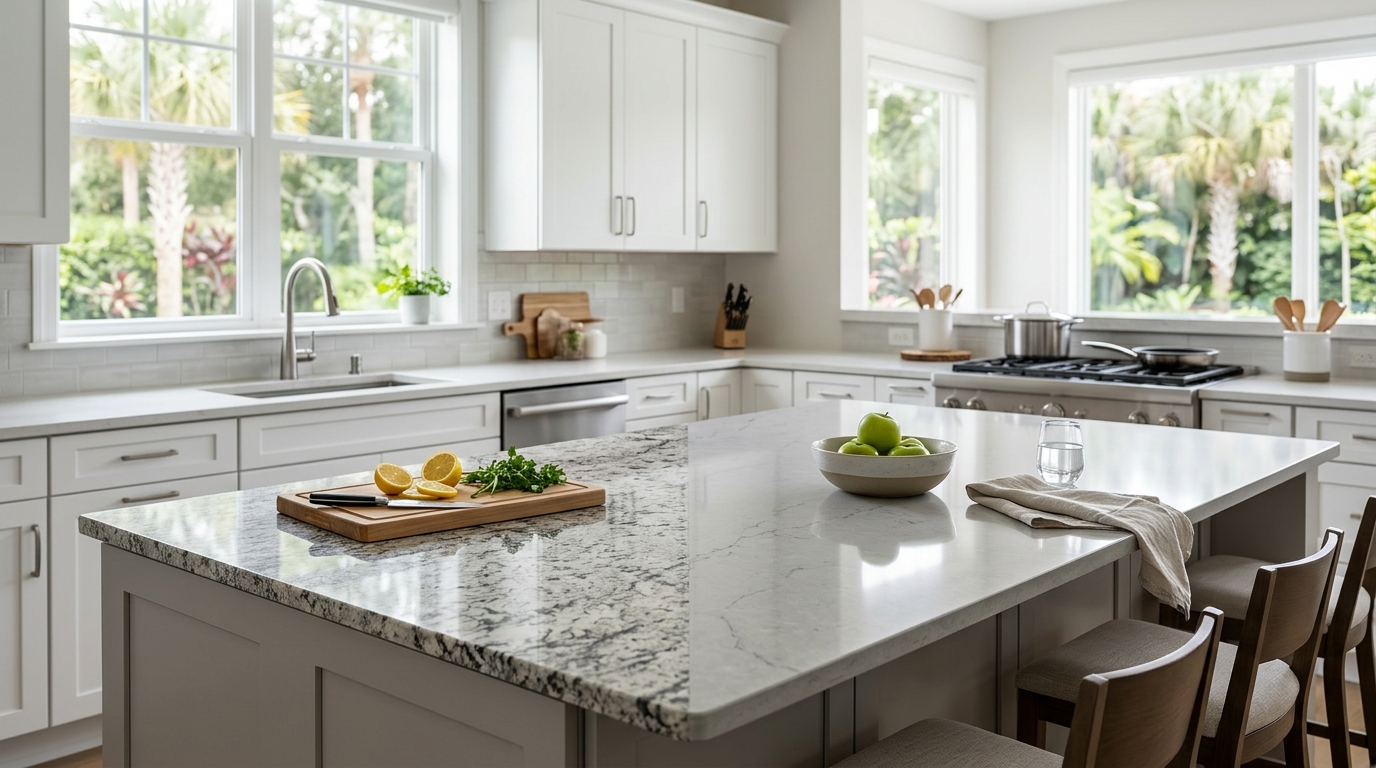
Granite vs. Quartz Countertops: Which Is Right for Your Jacksonville Home?
If you’ve started shopping for new countertops anywhere from Ponte Vedra to Orange Park, you’ve probably already asked the question that nearly every Jacksonville homeowner asks within the first ten minutes of walking into a showroom: granite or quartz? It’s the most common decision in any kitchen or bathroom remodel, and for good reason. Both materials look stunning, both add real value to your home, and both come with their own personalities, price points, and care routines.
The short answer? Granite is the better choice if you love natural, one-of-a-kind stone, want excellent heat resistance, and don’t mind a small annual sealing routine. Quartz is the better choice if you want a non-porous, virtually maintenance-free surface with consistent patterns and modern color options. Neither is universally “better” — the right pick depends on your lifestyle, your kitchen habits, and what you want your home to feel like every morning.
This guide is written specifically for Jacksonville homeowners. We’ll walk through what each material actually is, how they compare side by side, how Florida’s heat and humidity factor into the decision, and how to figure out which one fits your family. By the end, you’ll know exactly which surface belongs in your home — and you’ll have the confidence to move forward with your remodel.
Why This Question Matters So Much in Jacksonville
Jacksonville kitchens get used hard. Between back-porch entertaining, weekend grilling, summer humidity, and busy school-year mornings, your countertops live through a lot. We see homeowners across Riverside bungalows, San Marco historic homes, Ponte Vedra new builds, and Orange Park family kitchens all wrestling with the same comparison — and the choice they make often shapes how the kitchen feels and functions for the next 20 years.
The good news is that both granite countertops Jacksonville buyers love and quartz countertops Jacksonville FL homeowners are choosing in record numbers are excellent surfaces. The question isn’t really which is “best” — it’s which is best for you. Let’s start by looking at each one on its own terms.
What Is Granite?
Granite is 100% natural stone, quarried from the earth in massive blocks and then cut into slabs. Each slab is unique — no two pieces of granite are ever exactly alike. The colors, veining, mineral flecks, and movement you see in a granite countertop were formed over millions of years deep beneath the earth’s surface, and that natural origin is a huge part of granite’s appeal.
Natural Beauty You Can’t Replicate
When Jacksonville homeowners walk into our showroom and see granite slabs lined up, the reaction is almost always the same — they reach out and touch them. There’s something about real stone that engineered surfaces can’t fully imitate. The depth, the way light catches the crystals, the subtle shifts in color across a single slab — it’s like having a piece of natural art on top of your cabinets.
Some of the most popular granite colors we carry for Jacksonville homes include:
- New Caledonia — A versatile gray-and-black granite with subtle burgundy specks. Works beautifully in transitional kitchens and pairs with white, gray, or wood cabinets.
- Ubatuba — A deep, classic black-green granite with golden flecks. A favorite in San Marco and Avondale historic homes where homeowners want timeless elegance.
- Luna Pearl — A light, neutral granite with soft gray and beige tones. Perfect for bright coastal kitchens in Ponte Vedra and the beaches.
- Black Pearl — A dramatic dark granite with iridescent silver and copper flecks that shimmer under kitchen lighting. Stunning in modern and contemporary homes.
Heat Resistance and Durability
Granite is one of the most heat-resistant countertop materials you can buy. Set a hot pan straight from the stove on a granite surface, and the stone won’t blister, discolor, or warp. It’s also extremely hard — granite ranks high on the Mohs hardness scale, meaning it resists scratches from knives and everyday kitchen wear remarkably well. Drop a heavy pan? Granite shrugs it off in most cases.
The Sealing Question
Here’s the one trade-off: granite is a porous natural stone. To keep liquids from absorbing into the surface, granite countertops should be sealed. The good news is that sealing takes about 15 minutes once a year, the sealers are inexpensive, and modern granite sealants last 12 months or longer. Once sealed, granite is highly stain-resistant and easy to clean with mild soap and water.
What Is Quartz?
Quartz countertops are an engineered stone product. They’re made by combining roughly 90–95% crushed natural quartz with about 5–10% polymer resins and pigments, then pressing and curing the mixture into solid slabs. The result is a surface that looks like natural stone but performs like a high-tech material.
Engineered for Modern Living
Because quartz is manufactured rather than quarried, it offers something granite physically can’t: consistency. If you fall in love with a quartz pattern in the showroom, the slab in your kitchen will look essentially identical. For homeowners who want a specific look — a clean white surface with subtle veining, a true solid color, or a precise marble-look pattern — quartz is often the answer.
Non-Porous and Low Maintenance
This is quartz’s biggest practical advantage. Because the resins seal the surface at a molecular level, quartz is non-porous. Liquids can’t soak in. That means:
- No sealing required — ever.
- Highly stain-resistant against red wine, coffee, citrus juice, and oil.
- Naturally hygienic, since bacteria and moisture can’t penetrate the surface.
- Daily cleanup is just soap and water or a mild surface cleaner.
Trusted Quartz Brands
Not all quartz is created equal. The brand matters because it determines the resin quality, color stability, warranty, and overall durability. We work with the top names in the industry:
- Cambria — American-made, family-owned, with a lifetime warranty. Known for sophisticated marble-look patterns.
- Caesarstone — One of the original quartz manufacturers. Excellent range of contemporary and minimalist designs.
- Silestone — A global leader, offering a wide color palette including warm earthy tones and bold modern shades.
Heat Sensitivity
The one limitation of quartz is heat. Because it contains polymer resins, sustained high temperatures (think a cast-iron skillet straight off the burner) can damage or discolor the surface. It’s not a deal-breaker — trivets and hot pads solve the problem entirely — but it’s something to know.
Granite vs. Quartz: Side-by-Side Comparison
Here’s the head-to-head breakdown Jacksonville homeowners ask for most often:
Durability in Real Kitchens
Both materials are built to last decades. Granite’s natural hardness gives it a slight edge in scratch resistance — you can technically cut directly on granite (though we always recommend a cutting board to protect your knives). Quartz, because of its resin content, has a tiny bit of flexibility that actually helps it resist chipping along edges, especially around sinks and on overhangs.
Maintenance Reality Check
If you ask Jacksonville homeowners which they find easier day-to-day, quartz usually wins by a small margin. There’s something liberating about never having to think about sealing or worrying about a glass of red wine left overnight. That said, granite owners who establish a simple yearly sealing habit rarely complain — it’s truly a 15-minute task.
Heat Resistance in a Cooking Kitchen
If you cook a lot — we mean cast-iron, multi-burner, “everyone’s coming over for the Jaguars game” cooking — granite’s heat tolerance is a real advantage. Quartz is fine for everyday cooking with normal trivet use, but granite genuinely doesn’t care what you put on it.
Stain Resistance and Cleanup
Quartz wins this category clearly. Coffee, wine, turmeric, berry juice — none of it stands a chance on a non-porous surface. Sealed granite handles spills well too, but the seal is the variable. If you let it lapse, granite becomes more vulnerable.
Cost Considerations
Pricing for both materials varies widely based on color, pattern, slab thickness, edge profile, and installation complexity. In general, entry-level granite is often the most affordable upgrade from laminate, while premium granites and most quartz brands occupy a similar mid-to-upper price range. Specific imported granites and designer quartz patterns can reach the highest tier.
Appearance and Style
This is where personal taste rules. If you want your kitchen to feel earthy, organic, and one-of-a-kind, granite is hard to beat. If you want a clean, modern, predictable look — especially the popular white-and-gray marble-look styles dominating contemporary design — quartz is usually the answer.
The Florida Factor: How Jacksonville’s Climate Affects Your Choice
Here’s something most national articles won’t tell you: where you live actually matters when choosing countertops. Jacksonville’s climate — hot summers, humid air, salty coastal breezes, and the occasional hurricane-season power outage — creates a unique environment for kitchen materials.
Heat and Humidity
Jacksonville summers regularly push indoor humidity high, especially in older Riverside and Springfield homes where AC runs hard. The good news: both granite and quartz handle humidity beautifully. Neither material warps, swells, or degrades from moisture exposure — a major advantage over wood butcher block or even some laminates.
Granite has a subtle advantage worth mentioning: it “breathes” naturally. As a porous natural stone (sealed at the surface but still a natural material), it adapts to ambient temperature and humidity changes without any structural stress. This is one reason granite has been the countertop of choice in Florida for decades.
Quartz, despite being engineered, also handles Florida humidity exceptionally well. Indoor humidity has essentially no effect on quartz countertops. The only consideration is direct, sustained sunlight — which brings us to the next point.
Sun Exposure
Many Jacksonville homes have big windows, sliding doors to lanais, and bright sunny kitchens — especially in newer Nocatee and Ponte Vedra builds. If your countertop sits in direct sunlight for hours every day, granite is the safer pick. UV light over many years can cause some quartz colors to fade or yellow, particularly lighter shades. Manufacturers have made huge improvements, but most quartz warranties still recommend indoor use only.
Translation: granite is the right choice for outdoor kitchens, summer kitchens, and pool-deck bars. Quartz belongs indoors where it absolutely shines.
Coastal Considerations
Homes near the beaches — Atlantic Beach, Neptune Beach, Jacksonville Beach, Ponte Vedra — deal with salty air. Both granite and quartz are highly resistant to salt corrosion, far more so than wood, metal, or laminate surfaces. Either is a smart coastal choice.
Hurricane Season Practicality
During power outages, indoor temperatures can climb. Both surfaces handle this without issue. And if you’re prepping food on a camping stove during a storm? Granite’s heat tolerance gives it a slight edge for emergency cooking situations.
Which Countertop Is Right for You?
Here’s the part where we help you actually decide. Read through these scenarios and see which sounds most like your household.
The Busy Family
Three kids, two sports schedules, spaghetti night every Tuesday. Quartz is your friend. Non-porous, stain-resistant, no sealing — it forgives the chaos.
The Serious Cook
You sear, sauté, and pull cast iron from a 500° oven. Granite takes the heat without flinching, and the natural texture suits a working kitchen.
The Entertainer
Wine, charcuterie, weekend dinner parties on the lanai. Quartz shrugs off red wine and acidic foods. Granite wins if your bar is outdoors.
The Resale-Focused Owner
Selling within five years. Both add value. Granite appeals to traditional buyers; quartz wins with younger, modern buyers.
The Design Purist
You want one specific look replicated perfectly across an island and perimeter. Quartz gives you slab-to-slab consistency granite can’t match.
The Nature Lover
You want something authentic, geological, with character. Granite — every slab is a million years of earth’s history.
Lifestyle Self-Check Questions
Still on the fence? Run through these honest questions:
- Do I cook with high heat regularly, or are most meals quick and casual?
- Will I actually remember to seal a countertop once a year?
- Do I prefer surfaces with personality or surfaces that look uniform and modern?
- Will the countertop ever sit in direct, sustained sunlight?
- Am I drawn to the look of natural stone or to the clean look of marble-style patterns?
- Will this surface live in a heavily-used kitchen, a butler’s pantry, or a low-traffic bath?
If “low maintenance” and “modern look” appear in most of your answers, quartz is your match. If “natural beauty,” “heat resistance,” and “outdoor-ready” come up more, granite wins.
Common Use Cases Around Jacksonville
It helps to see how these decisions actually play out in real Jacksonville homes. Here are patterns we see across the area:
Historic Riverside and Avondale Homes
Older bungalows and craftsman-style homes in Riverside and Avondale tend to look stunning with traditional granites — Ubatuba, New Caledonia, and Black Pearl complement original wood floors and vintage cabinetry beautifully. Granite’s classic feel respects the architecture.
Modern Nocatee and Ponte Vedra Builds
Newer construction in Nocatee, Ponte Vedra, and the World Golf Village area often goes contemporary — white shaker cabinets, large islands, open floor plans. Quartz dominates here, especially the marble-look whites and grays from Cambria and Caesarstone.
San Marco and Mandarin Family Homes
Family kitchens in San Marco, Mandarin, and Julington Creek lean toward versatile choices. Light granites like Luna Pearl or mid-tone quartzes both work well — the deciding factor is usually whether the homeowner wants natural variation or pattern consistency.
Orange Park and Westside Renovations
Renovation budgets often favor granite in Orange Park, Westside, and Argyle, where homeowners get the best value-to-beauty ratio. Entry-level granites can transform a kitchen for less than mid-range quartz, and the durability is identical.
Beaches and Coastal Properties
For homes near Atlantic, Neptune, and Jacksonville Beach, we often recommend granite for outdoor kitchens and quartz for the indoor ones — letting each material work where it shines best.
Edge Cases Worth Knowing
Bathroom Vanities
For bathrooms, both materials work great, but quartz has a slight edge thanks to its resistance to cosmetics, hair dye, and toothpaste residue. That said, a small bathroom with a single vanity is also a perfect place to splurge on a striking granite remnant at a fraction of full slab cost.
Outdoor Kitchens
Granite only. UV exposure and temperature swings are too much for most quartz warranties. If you’re building a summer kitchen on your lanai or by the pool, choose granite — and choose a darker color that handles sun beautifully.
Waterfall Edges and Large Islands
Both materials work for waterfall edges, but quartz often produces a more seamless visual flow because of its consistent pattern. Granite waterfalls are stunning too, with the natural movement wrapping the edge — but expect visible seams where slabs join.
Repair and Replacement
If you ever damage a section of countertop, granite is generally easier to repair locally with epoxy fills. Quartz repairs are possible but more specialized. Replacement of a single damaged section is challenging for both — you’ll likely want to match an existing slab carefully.
What About Other Materials?
You may have heard about marble, quartzite, soapstone, or solid surface options. Briefly:
- Marble — Beautiful but soft, easily etched by acidic foods. Better for low-traffic baths than busy Jacksonville kitchens.
- Quartzite — Often confused with quartz, but quartzite is actually a natural stone — harder than granite, with marble-like looks. Excellent option, typically priced at the higher end.
- Soapstone — Rustic, soft, develops a patina over time. Niche choice for specific design aesthetics.
- Solid surface (Corian, etc.) — Lower cost, but lower durability and resale value than granite or quartz.
For most Jacksonville homeowners, the granite-versus-quartz decision is the right one to focus on — these two materials hit the sweet spot of beauty, durability, value, and longevity.
The Bottom Line
There’s no wrong answer between granite and quartz. Both will give you a beautiful, durable, valuable countertop that lasts decades. The real question is which one fits the way you actually live.
Choose granite if: you love natural materials, cook with high heat, want maximum heat tolerance, plan an outdoor kitchen, or prefer the timeless look of real stone with unique character.
Choose quartz if: you want the absolute easiest maintenance, prefer consistent modern patterns, want non-porous performance against stains, or are designing a contemporary space where a clean, predictable look matters.
And honestly? Many Jacksonville homes use both — granite on the perimeter where heat and durability matter, quartz on the island where the family gathers, or vice versa. There’s no rule that says you have to pick just one.
Ready to See Your Options in Person?
The best way to choose between granite and quartz is to see and touch the slabs in our Jacksonville showroom. Bring a cabinet sample, your floor swatch, or just your phone — we’ll help you find the perfect match for your home.
⭐ Right now: 50% OFF on countertops Jacksonville Florida homeowners are loving.
Get Your Free EstimateFrequently Asked Questions
Is quartz really more expensive than granite?
Not always. Entry-level granite is often the most affordable real-stone option in Jacksonville, while premium imported granites can match or exceed the cost of mid-range quartz. Mid-range quartz from brands like Silestone, Caesarstone, and Cambria typically falls in the same price band as mid-range granite. The total installed price depends more on color, slab availability, edge profile, and your kitchen’s complexity than on the material category alone. We always recommend getting an estimate based on your specific layout — sometimes the surface you assumed was out of budget is actually within reach.
How long do granite and quartz countertops last in a Florida home?
Both materials are designed to last the lifetime of your home — typically 25 to 50+ years with proper care. Florida’s humidity, heat, and coastal conditions don’t shorten the lifespan of either material when installed correctly. The biggest factor in longevity is installation quality: properly supported slabs, correctly sealed seams, and professional edge work. We’ve seen granite installed in Jacksonville homes 30 years ago that still looks fantastic, and quartz, while newer to the market, has performed beautifully in our region for over two decades.
Can I cut directly on granite or quartz?
You technically can on granite — it’s hard enough to handle a knife blade. But you’ll dull your knives quickly, and we never recommend it. On quartz, avoid cutting directly on the surface; while it won’t typically chip, the resin can show fine scratches over time. Use a cutting board on either surface. It protects your investment, keeps your knives sharp, and adds essentially zero inconvenience to your routine.
Do granite countertops emit radon, and is that a concern in Jacksonville?
This question comes up occasionally. Most granite contains trace amounts of naturally occurring radioactive elements, but extensive testing has consistently found that countertop-level emissions are negligible — far below any level of health concern. The U.S. Environmental Protection Agency and major granite industry studies have confirmed granite countertops are safe for residential use. Jacksonville homes have featured granite for decades without any documented health issues related to the material. If you ever have specific concerns about a particular slab, we’re happy to discuss it.
Which holds up better around a Jacksonville pool or outdoor kitchen?
Granite, hands down. UV resistance, heat tolerance, and weather durability all favor granite for outdoor applications. Most quartz manufacturers explicitly recommend indoor-only installation, and outdoor quartz often voids warranties. For pool decks, summer kitchens, and lanai bars throughout Ponte Vedra, the beaches, and Nocatee, we recommend a darker granite that resists fading and handles direct Florida sun beautifully.
Your Next Step
You now know the real difference between granite and quartz, how each performs in Jacksonville’s climate, and which one likely fits your home. The next step is simple: see them in person. Photos and articles can only take you so far — countertops are tactile, and the right slab almost always makes the decision for you the moment you see it.
Whether you’re remodeling a Riverside kitchen, upgrading a Mandarin bathroom, building new in Nocatee, or planning an outdoor kitchen at the beach, we’d love to help you find the perfect surface. Stop by our Jacksonville showroom, browse our extensive granite and quartz inventory, and let our team walk you through pricing, installation, and timeline — no pressure, no pushy sales. Just honest local advice from people who’ve been doing this in Jacksonville for years.
And don’t forget — our current 50% off sale on countertops Jacksonville Florida homeowners are talking about means there’s never been a better time to upgrade. Request your free estimate today and let’s bring your dream kitchen to life.